
Artificial Intelligence and Machine Learning Course
Doctor of Business Administration in Artificial Intelligence and Machine Learning
 Application closes on
20th Mar 2026
Application closes on
20th Mar 2026
 Speak with our expert
+1 248 970 1937
Speak with our expert
+1 248 970 1937




Learn more about the course
Get details on syllabus, projects, tools, and more

Sorry, this content is currently not available
in your region
Continue to check out similar courses available to you
EXPLORE COURSES
Doctor Of Business Administration in Artificial Intelligence and Machine Learning
Application closes 20th Mar 2026
What's new?
-

Build expertise in Generative AI
Dive deep into cutting-edge Generative AI concepts, leveraging tools like ChatGPT and Hugging Face Transformers library to access LLMs for text generation, summarization, and other advanced applications.
-
Modules on MLOps and Multimodal AI
With our Artificial Intelligence course, master MLOps for seamless model deployment alongwith Multimodel AI to integrate and process diverse data types effectively


Program Outcomes
Transform business and drive growth with AI
Drive business transformation as a strategic AI leader
-

Gain strategic insights to manage and execute AI projects effectively
-
Build innovative AI-powered products and services to drive growth
-
Boost your career with a globally recognized credentials
-
Demonstrate mastery and earn the title of 'Dr.'
Earn Doctoral and Master's Degrees from the World's Leading Institution
-
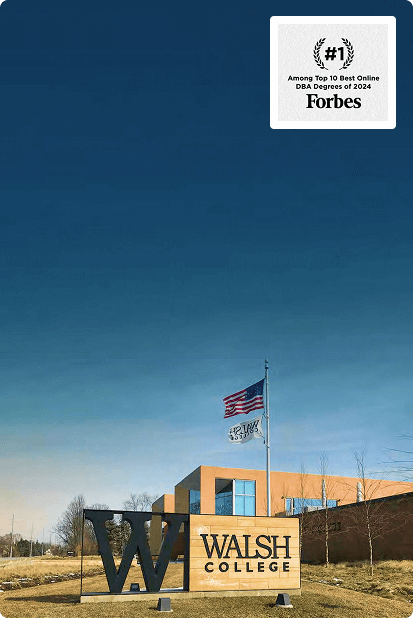
Ranked #1 among top 10 best Online DBA Degrees of 2024
Forbes
-
Top Tier 1 ranking for DBA
Global DBA Ranking by CEO Magazine
-
Accredited by the HLC
Accreditation agency recognized by the U.S. Department of Education


Key program highlights
Why choose the DBA in AI & ML program
-
Top ranked DBA by Forbes
Ranked among top 10 online DBA degrees of 2024 by Forbes for academic quality and industry relevance.
-
Hands-on projects followed by thesis
Work on numerous real world projects followed by capstone projects and a final dissertation with dedicated guidance from top faculty and industry experts.
-
WES recognized and HLC accredited
Ensures global acceptance and enhances career and academic opportunities.
-
Alumni status from Walsh College
Earn alumni status from Walsh College upon program completion.
-
Expert mentorship and support
Interact with AI experts for guidance on completing and showcasing your projects, while receiving 1:1 personal assistance, weekly concept reinforcement sessions, and dedicated support from a program manager for any queries.
-
Added Modules on Generative AI and Prompt Engineering
Gain practical knowledge of transformer architectures, Retrieval-Augmented Generation (RAG), and prompt engineering to build effective NLP solutions using open-source LLMs.
-
A cohort of experienced leaders
40% of participants are senior-level professionals, and 60% are in leadership roles, bringing diverse expertise and strategic insights.
-
Powerful Global Network
Connect with peers from Amazon, Microsoft, JPMorgan, and others. Unlock top-tier career opportunities beyond the classroom.
*The list of companies is indicative and may vary based on cohorts


Skills you will learn
Generative AI
Prompt Engineering
Machine Learning
Research Methodology
Academic Writing & Publication
Deep Learning
Neural Networks
Business Intelligence Using AI
AGENTIC AI
AI Strategy & Ethics
Large Language Model
Natural Language Processing
Retrieval-Augmented Generation
AI Business Application
Generative AI
Prompt Engineering
Machine Learning
Research Methodology
Academic Writing & Publication
Deep Learning
Neural Networks
Business Intelligence Using AI
AGENTIC AI
AI Strategy & Ethics
Large Language Model
Natural Language Processing
Retrieval-Augmented Generation
AI Business Application
view more
Careers after a DBA in AI and ML
Top career roles for DBA graduates
Here are high-impact roles typically pursued by DBA in AI and ML graduates:
-
Chief AI officer
-
Director – AI strategy
-
AI/ML Solutions architect
-
Senior data scientist
-
Head of AI/ML research
-
AI and ML consultant
- Overview
- Career Transitions
- Why GL
- Learning Journey
- Curriculum
- Projects
- Tools
- Certificate
- Faculty
- Reviews
- Career support
- Fees
- FAQ

This program is ideal for
The DBA in AI & ML is designed to empower working professionals and senior leaders to drive innovation, lead transformation, and create research-backed business impact
View Batch Profile
-
Senior professionals
Elevate your career with advanced leadership skills, applied research capabilities, and AI-driven business strategies
-
Domain experts and functional Leaders
Integrate AI/ML into functional areas like marketing, finance, operations, and HR to solve complex business problems
-
CXOs and business heads
Strengthen your strategic edge and guide your organization’s AI transformation with global insights and doctoral-level expertise
-
Technology leaders
Lead AI initiatives and innovation teams with a deep understanding of technical architectures and their business impact
Experience a unique learning journey
Our pedagogy is designed to ensure career growth and transformation
-
Learn with self-paced videos
Learn critical concepts from video lectures by faculty & AI experts
-
Engage with your mentors
Clarify your doubts and gain practical skills during the weekend mentorship sessions
-
Work on hands-on projects
Work on projects to apply the concepts & tools learnt in the module
-
Get personalized assistance
Our dedicated program managers will support you whenever you need





Ready to take the next step?

-
Explore a sample course from our faculty
-
Know more about the case-studies & projects
-
Experience a sample mentorship session with an industry expert

Application closes in:
2
Days
0
8
Hrs
3
2
Mins
3
1
Secs

-
Get a detailed program overview
-
Understand how this program can help achieve your career goals
-
Get more information about the admission process & next steps
50,000+ learners found this helpful
Curriculum
-
225+ hrs
learning content
-
10+
languages & tools
Phase 1
Foundation
Introduction to Data Science and AI (Self-paced Module)
Python for Artificial Intelligence and Machine Learning
Applied Statistics
Machine Learning
Supervised Learning
Unsupervised Learning
Ensemble Techniques
Featurization, Model Selection, and Tuning
Introduction to SQL
Artificial Intelligence
Introduction to Generative AI and Prompt Engineering
- Introduction to Neural Networks and Deep Learning
- Computer Vision
- Natural Language Processing
- Self-paced Module: Demystifying ChatGPT, GenAI, and Its Applications
- Self-paced Module: ChatGPT-the Development Stack
Phase 2
Term 1
In this module, you will master CNNs, RNNs, LSTMs, autoencoders, and state-of-the-art Generative models like GPT, PaLM, CLIP, and DALL·E, and gain the industry-critical skills of transfer learning, Prompt Engineering, and RAG and LoRA fine-tuning to create domain-specific AI systems ready for real-world impact. Database storage technologies have evolved into complex systems that support knowledge management and decision support.
- Introduction to Deep Learning
- Neural Networks and Backpropagation
- CNN, RNN, LSTM
- Autoencoders and Generative Models
- Transfer Learning
- Prompt Engineering basics
- Foundation Models GPT, PaLM, CLIP, DALL·E
- RAG, LoRA
Data Storage Technologies
This module examines the foundations of database storage technologies. Students will learn about database storage architecture, types of database storage systems (legacy, current, and emerging), physical data storage, transaction management, database storage APIs, data warehousing, governance, and big data systems.
- Evaluate Different Database Storage Technologies
- Compare Systems Used In Data Analytics
- Investigate Legacy, Current, And Emerging Systems
- Assess Database Storage Solutions Through Hands-On Labs
Term 2
AI Strategy for Leaders
The module integrates real-world case studies from industry leaders such as Tesla, Amazon, JPMorgan Chase, and Microsoft, providing students with insights into AI successes and challenges. Through case study analyses, discussions, and practical assignments, students will develop leadership strategies for AI integration, ensuring responsible and effective adoption of AI in their organizations.
- AI Fundamentals and Business Applications
- AI Vision and Strategy Development
- Ethical AI Leadership
- Building AI-Ready Teams
- AI Tools and Technologies
- Data Governance and Compliance
- Measuring AI Impact and Risks
- The Future of AI Leadership
Mathematics of Artificial Intelligence and Machine Learning
This module introduces and explains the fundamental mathematical concepts that form the backbone of Artificial Intelligence and Deep Learning. It emphasizes a strong understanding of linear algebra and analytic geometry, which are essential for building and optimizing AI models.
Upon successful completion of this module, students will be able to:
- Analyze the role of scalars, vector spaces, tensors, matrices, derivatives, and gradient descent.
- Apply fundamental linear algebra and its mathematics to solve problems in Artificial Intelligence and Machine Learning.
- Evaluate and select the most effective optimization methods and their mathematics for specific Artificial Intelligence and Machine Learning problems.
- Differentiate between the roles of probability in predicting future events and statistics in analyzing past events for their applications.
Term 3
The student will work with the Capstone Project Mentor to develop a proposal. After review and approval by the Capstone Project Mentor, the student will be authorized to complete the project. The student will present the completed project at the end of the semester.
Upon successful completion of this module, students will be able to:
- Demonstrate the knowledge gained from the previous modules in the program.
- Write a formal research paper or conduct a detailed project.
- Apply the objectives of research to a practical information technology problem.
- Create a project plan to successfully present a solution/goal to the stated problem.
- Use research tools for an applied research paper or project.
- Evaluate the validity and reliability of statistics and other forms of research.
Applied Research in Natural Language Processing (Only for Doctorate learners)
This module is designed to provide students with advanced knowledge and practical skills in Natural Language Processing (NLP) research and applications. Students will delve into cutting-edge techniques, methodologies, and tools used in NLP, with a focus on applied research and real-world use cases.
Upon successful completion of this module, students will be able to:
- Evaluate and apply advanced Natural Language Processing models and architectures to solve domain-specific language tasks.
- Design, implement, and optimize NLP models using state-of-the-art algorithms, evaluation metrics, and experimental design principles.
- Critically analyze the ethical, societal, and fairness implications of NLP technologies, and propose responsible solutions.
- Develop NLP systems that extract, generate, and interpret structured and unstructured data for diverse real-world applications.
- Conduct applied NLP research by formulating hypotheses, implementing models, and interpreting results to advance the field.
Term 4
This module introduces qualitative research and non-statistical forecasting methods, with a focus on the study of human behavior in organizations. It covers key qualitative approaches, such as ethnomethodology, grounded theory, and phenomenological research, as well as nonparametric analysis. By the end of the module, students will be equipped to frame qualitative research problems and design robust qualitative studies for doctoral research or future scholarly inquiry.
Quantitative Research Methods I
Data Management And Non-Experimental: This module is a combination of quantitative research methods, multivariate statistics, and forecasting. It assumes the doctoral student has had a graduate-level statistics/quantitative methods module covering parametric statistics and hypothesis testing.
Doctoral Residency I: This module is the first of three residencies. The residencies occur simultaneously with coursework throughout the student's doctoral journey. A residency experience aims to provide students with the opportunity to connect directly with faculty/mentors and fellow students in the doctoral program. Students will attend information sessions, meet with faculty/mentors regarding subject matter and research methodology experts, and present their problem/purpose statement to a review board for feedback and direction.
- Outcome: Finalization of project problems and purpose statements.
Phase 3
Quantitative Research Method II
This module is designed to build an advanced body of knowledge that will enable students to use an extensive array of complex statistical models, tools, and software applications to analyze numerical data. Additionally, students will be able to use these advanced techniques to perform predictive analytics.
- Advanced Non-experimental and Experimental Quantitative Research Methods
- Quasi-experimental Design and Analysis
- True Experimental Design and Analysis
- Research across Time and Space
- Explanation, Prediction, and Simulation
- Big Data, Artificial Intelligence, Machine Learning, and other inductive Methods and Approaches
Doctoral Residency II
Transition from coursework to dissertation research. Develop your dissertation proposal, gain ethical research approval, and begin collecting data for your study.
Doctoral Residency III
Advance your dissertation research and writing. Analyze your data, draft your dissertation chapters, and receive ongoing feedback from your dissertation committee.
Dissertation I – Chapter 1
Dissertation II – Chapter 2
Dissertation III – Chapter 3
Dissertation IV – Chapter 4
Dissertation V – Chapter 5
Master in-demand AI & ML tools
Get AI training with 27+ tools to enhance your workflow, optimize models, and build AI solutions
-
Python
-
SQL
-
NumPy
-
Pandas
-
Seaborn
-
scikit-learn
-
Keras
-
Tensorflow






Get certificates from the world's leading institutions
-
Internationally recognized DBA
Gain global recognition with HLC accreditation and WES recognition, ensuring wide international acceptance and credibility.
-
Prestigious credentials
Earn Doctoral and Master's Degrees from the World's Leading Institution
-
Lifetime alumni Status
Gain full alumni status from Walsh College and join an elite network of AI consultants, C-suite leaders, and entrepreneurs.


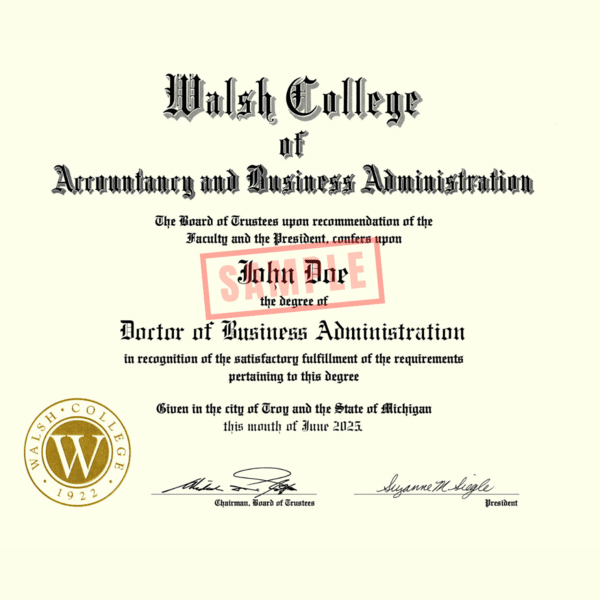
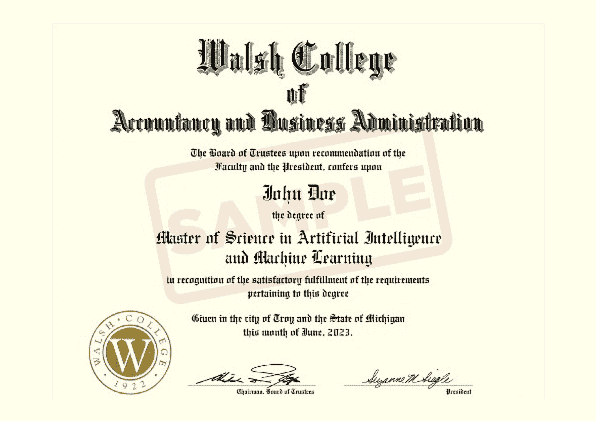
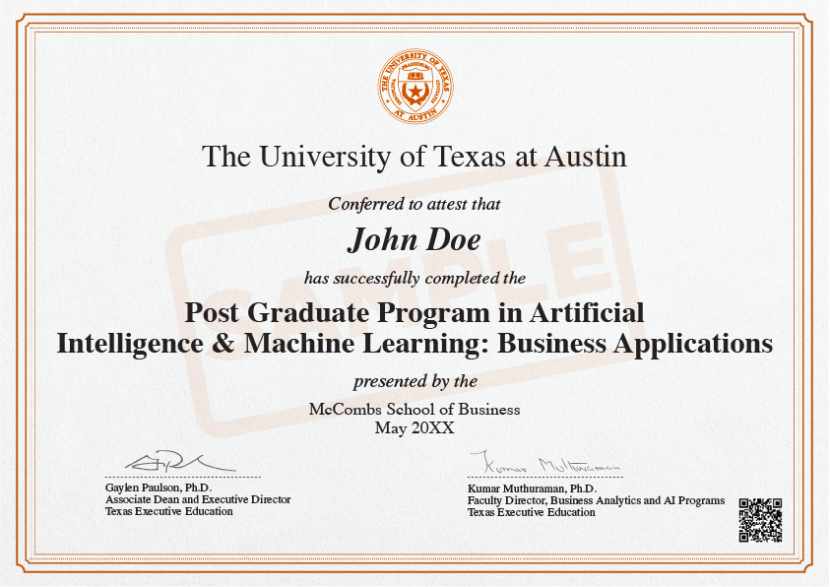
* Image for illustration only. Certificate subject to change.
Meet your faculty
-
Abbas Raftari
Adjunct Instructor
Know More
-
Kurt Godden
Senior Analytics Scientist - Ford Motor
Know More
-
Javed Katibai
Chassis System Architect - General Motors
Know More
-
Dr. Dave Schippers
VP and Academic Dean
Know More
-
Michael Rinkus
DBA, Lawrence Technological University
Know More
-
Drew Smith
PhD, Pacifica Graduate Institute
Know More
-
James Gerrity
PhD, Adjunct Associate Professor
Know More
-
Christopher Heiden
Program Lead at IT, Associate Professor of Business Information Technology
Know More
.jpg "Abbas Raftari - Faculty Director")







.jpg "Michael Rinkus - Faculty Director")





 LinkedIn Profile
 University Link
Get industry ready with dedicated career support
-
1:1 mentorship from industry experts
Get 1:1 career mentorship from our industry experts to prepare for jobs in AI and ML
-
Interview prep with experts
Participate in mock interviews and access our tips & hacks on the latest interview questions of top companies
-
Resume & profile review
Get your resume/cv and LinkedIn profile reviewed by our experts to highlight your AI & ML skills & projects
-
Access to Great Learning Job Board
Apply directly to top opportunities from leading companies with Great Learning Job Board




Course fees
The course fee is USD 12,550
Invest in your career
-
Gain global recognition with HLC accreditation and WES recognition
-
Earn alumni status from Walsh College upon program completion
-
Master AI & ML to solve complex, data-driven business problems
-
Earn a ‘Dr.’ title & get recognised as a specialist in your field


Application process
Our admissions close once the requisite number of participants enroll for the upcoming batch . Apply early to secure your seats.
-
1. Fill the application form
Apply by filling a simple online application form.
-
2. Interview Process
Go through a screening call with the Admission Director’s office.
-
3. Join program
An offer letter will be rolled out to the select few candidates. Secure your seat by paying the admission fee.


Eligibility
- Applicants must hold a 3 or 4-year bachelor’s degree or equivalent in any discipline with a minimum of 60% marks from a UGC-recognized university or institution. The medium of instruction must be in English.
- No GRE/GMAT or any English proficiency test scores are required.
Batch start date
-
Online · To be announced
Admissions Open
Frequently asked questions
What is the DBA in Artificial Intelligence (AI/ML) program about?
The Doctor of Business Administration (DBA) in Artificial Intelligence and Machine Learning is a doctoral-level program designed to help professionals understand, apply, and lead AI and ML initiatives in business contexts. The program combines rigorous academic foundations with real-world applications, enabling learners to use AI and ML for data-driven decision-making and organizational leadership
Is this DBA degree globally recognized?
Yes, this DBA Program by Walsh College is ranked among the top 10 Best online DBA degrees of 2024.
Are the Master's Degree and Doctorate WES-approved?
What is the duration and mode of the DBA in the Artificial Intelligence and Machine Learning program?
How is the Walsh DBA better than other doctorate degrees in Business Administration?
#1 Ranking for Best Online DBA Programs by Forbes; Awarded Top-Tier Global DBA Ranking by CEO Magazine ; WES recognized; Accredited by The Higher Learning Commission (HLC), a regional accreditation agency recognized by the U.S. Department of Education.
Why should you choose this DBA course in AIML?
What is the structure of this program?
Phase 1: Postgraduate Program in Artificial Intelligence and Machine Learning (AIML)
Learners begin with a Postgraduate program in AIML delivered by an academic partner institution.
Phase 2: Doctoral Program in AIML (DBA)
Upon successful completion of the postgraduate phase, learners progress to the Doctor of Business Administration in AIML offered by Walsh College.
Credentials Awarded:
Graduates earn a globally recognized DBA in Artificial Intelligence and Machine Learning from Walsh College, along with a Postgraduate Certificate from the partner institution associated with the learner’s pathway.
What kind of certificate will students receive upon completion?
For detailed information specific to your enrollment pathway, learners are encouraged to contact their Program Advisor.
What is the deadline to enroll in this program?
Admissions for the upcoming batch will close once we reach the required number of participants. Seats are limited and given out on a first-come, first-served basis. We encourage you to apply early to secure your spot in the program.
What possible assistance is provided to students in the final year of the dissertation?
The final year comprises a Dissertation, and to ensure students complete it without any challenges or rejection at a later stage, a Walsh faculty member will be assigned as a guide to show you the right direction.
What support does Walsh College provide to learners of the DBA Program?
The Doctor of Business Administration in Artificial Intelligence and Machine Learning (Walsh College) provides the following support to its learners:
- Flexible Learning: The program is 100% online, allowing learners to balance their studies with professional commitments.
- Capstone Projects and Dissertation Guidance: Learners undertake capstone projects in Year 1 and Year 2 and work with a capstone mentor, followed by a thesis (dissertation) in Year 3 under the supervision of faculty/mentors.
- Alumni Status: Graduates receive alumni status from Walsh College, which can foster networking and career support.
What are the learning outcomes?
Upon successful completion of the DBA program, you will be able to:
- Interpret and implement relevant AI and ML models to create new knowledge paradigms.
- Propel the field forward by expanding upon existing literature.
- Apply new-age AI techniques to solve real-world business problems.
- Develop research methodologies in alignment with philosophical paradigms.
- Generate fresh insights and offer justified recommendations.
- Upskill yourself as an ideal AI innovator with the latest skills to extract actionable insights for growth.
- Work as subject matter experts in your respective organizations and lead innovation/R&D projects.
Why is the DBA in AIML a better choice compared to other Doctor of Business Administration programs?
Unlike many programs that offer only basic AI exposure and limited career support, this DBA uniquely combines an MS, DBA, and PG Certificate with career guidance from Year 1. Recognized by global bodies such as the Higher Learning Commission and World Education Services, it ensures strong academic rigor and international credibility, making it an exceptional choice for professionals seeking both AI expertise and career growth.
How many hours per week are required for the DBA program?
Learners are encouraged to review the program structure and discuss workload expectations with a program advisor.
Who are some notable faculty members in this DBA program?
*Faculty list is indicative and subject to change.
What are the key subjects covered in the curriculum?
The program is structured across 3 years, progressing from foundational AI skills to advanced applications and research. For a detailed breakdown of modules and learning outcomes, learners are advised to refer to the official program brochure.
Are there hands-on projects included in the program?
Yes, the program includes Capstone Projects in Year 1 and Year 2, followed by a thesis in Year 3.
Is there a residency course component in the program?
Yes, the DBA curriculum includes Doctoral Residency I, II, and III courses.
What are the languages and tools covered in this program?
The languages and tools covered are Python, TensorFlow, NumPy, Matplotlib, Statsmodels, Keras, Scikit-learn, and Seaborn.
What are the eligibility requirements for this DBA program?
- Applicants must hold a 3- or 4-year bachelor's degree (or equivalent) in any discipline from a UGC-recognized university.
- The medium of instruction must be English.
- No GRE/GMAT scores are required.
For clarification on individual eligibility, applicants are encouraged to contact their program advisor.
Are international learners eligible for this online DBA?
The program is delivered online and supports learners across regions. Eligibility and documentation requirements may vary, and applicants are advised to speak with a program advisor for details
Is this an online DBA suitable for working professionals?
Yes. The program is offered in a 100% online format and is designed to support professionals alongside their existing work commitments. The structure emphasizes flexible learning while maintaining doctoral-level academic rigor
What is the admission process?
Step 1: Apply online
Fill out a fast and easy application form. No additional tests or prerequisites are needed.
Step 2: Pre-screening
Our team will contact you by phone to confirm your eligibility for the program.
Step 3: Application assessment
The admissions team will assess your application and provide a timely response.
Step 4: Join the program.
If selected, you will receive an acceptance letter with instructions on how to pay and join the program.
Note: Admission to the program is subject to Walsh College acceptance.*
Does the applicant need a Master’s degree to start the DBA?
No. A Master’s degree is not required to enroll in the Doctor of Business Administration (DBA) in Artificial Intelligence and Machine Learning. Applicants are eligible with a 3- or 4-year bachelor’s degree (or equivalent) from a recognized institution, as outlined in the program eligibility criteria.
What is the DBA online program fee?
For the most up-to-date information on the course fee, please refer to the official program page here.
What career advantages does a DBA in AI & ML offer compared to a PhD?
The DBA focuses on applied research, business leadership, and real-world AI implementation, making it suitable for senior professionals and industry leaders. In contrast, a PhD is typically more theory-oriented and academically focused.
What skills will I gain after completing the program?
The skills you will gain after completing the DBA program include:
- Implementing AI and ML models
- Applying AI techniques to solve business problems
- Developing research methodologies
- Generating insights
- Implementing Strategic AI Leadership
Who typically enrolls in this program?
The cohort consists mostly of professionals from IT (47.6%), manufacturing (19.05%), finance, education, marketing, consulting, pharma, and other industries, with work experience ranging primarily from 3 to 15+ years.
*This data is indicative and may vary based on cohorts.
Will I receive alumni status after completion?
Yes, graduates receive alumni status from Walsh College.
Will I receive any career support after completing the program?
Yes, you will receive career support from Great Learning, India’s renowned ed-tech platform for professional development and higher education.
T&C valid*
Can I publish research papers during the DBA program?
Yes. The program includes capstone projects, applied research modules, and a doctoral dissertation, which support scholarly research and the development of publishable work (subject to approval, if required, before publishing any findings related to a company involved)
What are the career opportunities after I complete a DBA degree online?
Here are high-impact career roles typically pursued by graduates of a DBA in AI and ML:
- Chief AI officer
- Director – AI strategy
- AI/ML solutions architect
- Senior data scientist
- Head of AI/ML research
- AI and ML consultant
 Application Closes
20th Mar 2026
Application Closes
20th Mar 2026

Similar free AI courses for you
-

 Beginner
 1.0 Hrs
Sentiment Analysis
-

 Beginner
 1.0 Hrs
Introduction to Text Mining
-

 Intermediate
 1.5 Hrs
Multilayer Perceptron
-

 Beginner
 1.0 Hrs
Deepfake Demo
-

 Beginner
 2.5 Hrs
Natural Language Processing Projects
-

 Intermediate
 1.5 Hrs
Batch Normalization
-

 Beginner
 2.0 Hrs
AI Applications in Healthcare
-

 Intermediate
 1.5 Hrs
Neural Network in R
-

 Beginner
 1.5 Hrs
Introduction to Computer Vision
-

 Intermediate
 1.5 Hrs
Semantic Segmentation Tutorial


Explore latest trends & topics
-
Top 6 Artificial Intelligence Documentaries
2025-05-15 08:33:42 UTC
-
Machine Learning Interview Questions and Answers
2025-05-14 13:36:35 UTC
-
Best First Search Algorithm in AI
2025-05-14 13:35:03 UTC
-
Top 50 NLP Interview Questions and Answers in 2025
2025-05-14 13:32:43 UTC
-
Top 10 Artificial Intelligence Books 2025
2025-05-14 12:42:54 UTC
-
Basics of building an Artificial Intelligence Chatbot - 2025
2025-05-14 12:30:41 UTC







Be part of an elite network of industry leaders
- A cohort of experienced leaders
40% of participants are senior-level professionals, and 60% are in leadership roles, bringing diverse expertise and strategic insights. - Top-tier industry representation
Leaders from technology, finance, healthcare, manufacturing, and consulting contribute to a rich knowledge exchange. - Connect with global powerhouses
Our learners are making an impact at Amazon, Microsoft, Goldman Sachs, JPMorgan, Walmart, and more*, creating invaluable networking opportunities that extend beyond the classroom.
More than education, this is your gateway to top-tier career opportunities.
*The list of companies is indicative and may vary based on cohorts.
Hey there! Welcome back.


Forgot your password? No problem.

You are already registered. Please login instead.
Login
Forgot Password?
Enter your registered email and we'll send you a link to change your password.