Free Python Data Structures Course
Python Data Structures
 4.5
Beginner level
1.5 learning hrs
4.5
Beginner level
1.5 learning hrs
Enroll in this free Python Data Structures and transform your coding skills! Learn how to efficiently store and manage data using lists, dictionaries, and more. Get hands-on experience and take control of your data with Python.




About this course
In this free Data Structures in Python Course, you will learn about the four inbuilt data structures. You will start this course by learning the basic concepts of Python such as its features and uses. Then, you will be briefed about the different types of data structures in Python starting from Lists which is a collection of values with the same or different type. Then we will jump to the Tuple data structure in Python which is immutable. Then comes Set, which is a collection of unique elements, and a dictionary(having key and value pair). Before summing up the Python Data Structures Course, you will also go through the various differences between each data structure in Python & when to use which data structure. The differences will be between List vs Tuple, List vs Set, List vs Dictionary.
Explore our Software Engineering Courses today.
Data structures in Python are the collections of related data values, or objects, which are organized in a particular way. Python provides various types of data structures, such as lists, dictionaries, tuples, sets, and more.
Each of these data structures has a specific purpose and allows for efficient manipulation of data. Lists are one of the most commonly used data structures in Python. They are used to store an ordered sequence of elements, and can be manipulated using a variety of methods and functions. Dictionaries are another popular data structure in Python. They store key-value pairs, and are useful for storing a large amount of data.
Tuples are similar to lists, but are immutable, meaning that their values cannot be changed. Sets are collections of unique elements, and are often used for finding common elements between two sets of data. Python also provides powerful data structures such as queues and stacks, which are used for managing data in a specific order. By understanding the different types of data structures in Python, developers can create more efficient and powerful applications.
Course outline
Introduction to Python
This module starts by briefly introducing Python programming, and you will go through its installation process and some essential hands-on examples.
Dictionary
Dictionary is an unordered collection that contains key-value pairs in it. You will learn to use the dictionary to store and define values to the key you declared in this module. The tutor will explain how to access the values using the keys from the dictionary.
Get access to the complete curriculum once you enroll in the course
 4.5
4.5
Level up with advanced skills & become job ready with Pro+
Subscribe to Pro+ today to build skills with 50+ Pro courses and prep for jobs with advanced AI tools.
 PRO
PRO
.jpg)

Practice exercises
Guided Projects
AI Resume Builder
AI mock interviews






 India
India
 India
India
 India
India
 India
India

 Philippines
 India
India
 India
India
 India
India
 India
India
 India
India
Frequently Asked Questions
Will I receive a certificate upon completing this free course?
Is this course free?
Can Python be used for data structures?
Yes, Python can be castoff for data structures as Python has primitive (or basic) data structures such as floats, integers, strings, and Booleans. Python similarly has non-primitive data structures such as lists, tuples, dictionaries, and sets. Non-primitive data structures hoard a collection of values in various formats rather than a single value.
Is python good for data structures?
Python is well-thought-out to is a good language to initiate with if you are a learner or beginner. Moreover, in terms of speed, there is no improved language than Python. In the facets of speed, accessibility, and syntax, python is a good language for Data Structures.
Is Python data structure easy to learn?
Python is an easy programming language to acquire and learn nevertheless if you take help from a well-structured Python Data Structures course. You should focus on the basics before diving into the python data structures details.
What are the 4 built-in data structures in Python?
The 4 built-in data structures in Python are list, set, tuples, and dictionary.
Where can I learn data structures in Python?
You can take up a free Python data structures course at Great Learning Academy. Start with the basics of data structures in python, learn about the differences in each one of them before deep diving into detailed python data structures and algorithms.
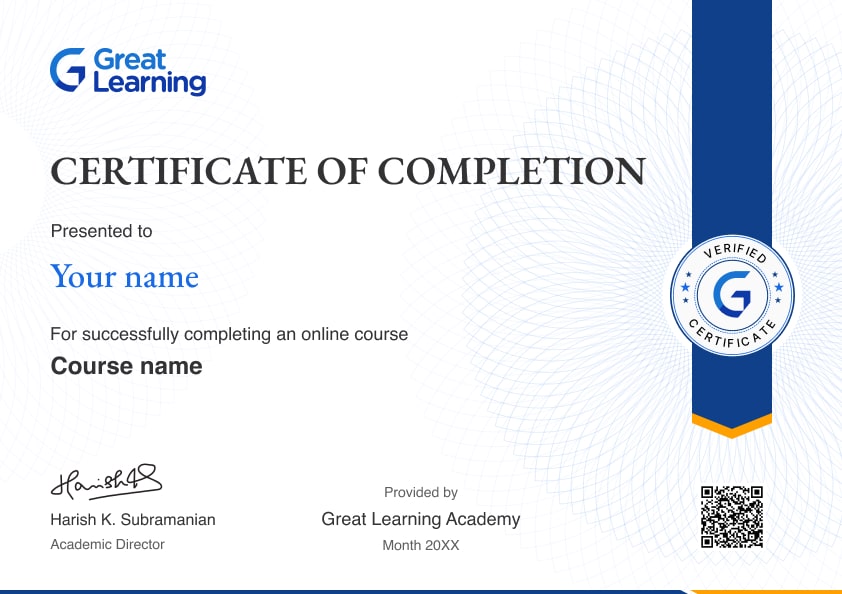
Will I get a certificate after completing this Python Data Structures free course?
Yes, you will get a certificate of completion for Python Data Structures after completing all the modules and cracking the assessment. The assessment tests your knowledge of the subject and badges your skills.
How much does this Python Data Structures course cost?
It is an entirely free course from Great Learning Academy. Anyone interested in learning the basics of Python Data Structures can get started with this course.
Is there any limit on how many times I can take this free course?
Once you enroll in the Python Data Structures course, you have lifetime access to it. So, you can log in anytime and learn it for free online.
Can I sign up for multiple courses from Great Learning Academy at the same time?
Yes, you can enroll in as many courses as you want from Great Learning Academy. There is no limit to the number of courses you can enroll in at once, but since the courses offered by Great Learning Academy are free, we suggest you learn one by one to get the best out of the subject.
Why choose Great Learning Academy for this free Python Data Structures course?
Great Learning Academy provides this Python Data Structures course for free online. The course is self-paced and helps you understand various topics that fall under the subject with solved problems and demonstrated examples. The course is carefully designed, keeping in mind to cater to both beginners and professionals, and is delivered by subject experts. Great Learning is a global ed-tech platform dedicated to developing competent professionals. Great Learning Academy is an initiative by Great Learning that offers in-demand free online courses to help people advance in their jobs. More than 5 million learners from 140 countries have benefited from Great Learning Academy's free online courses with certificates. It is a one-stop place for all of a learner's goals.
What are the steps to enroll in this Python Data Structures course?
Enrolling in any of the Great Learning Academy’s courses is just one step process. Sign-up for the course, you are interested in learning through your E-mail ID and start learning them for free online.
Will I have lifetime access to this free Python Data Structures course?
Yes, once you enroll in the course, you will have lifetime access, where you can log in and learn whenever you want to.
Become a Skilled Professional with Pro Courses
Gain work-ready skills with guided projects, top faculty and AI tools, all at an affordable price.







.jpg)




.png)
.png)

.png)


.png)
.jpg)

.jpg)
.png)
.jpg)
.jpeg)







.png)
.png)
.png)
.png)
.png)
.jpg)
.jpg)
.png)

.png)
.png)




 (1).png)

.png)
.png)
.png)
.png)

.png)

 (1).jpg)

.png)
.png)
.png)
.png)

.png)
.png)

.png)



Recommended Free Python courses
 FREE
FREE
 FREE
FREE
 FREE
FREE

Similar courses you might like
FREE
.jpg) FREE
FREE
 FREE
FREE
 FREE
FREE