
Free Gemini Course for Accounting
Google Gemini for Accounting
 4.36
Beginner level
3.0 learning hrs
4.36
Beginner level
3.0 learning hrs
Learn how to use Gemini for accounting tasks, financial analysis, and step-by-step problem-solving. Join our free Gemini Course for accounting to apply Gemini in spreadsheets and automate workflows in modern accounting.




About this course
This free Gemini course for accounting professionals helps you understand how modern AI can support core accounting work and improve financial decision-making. You will learn the fundamentals of Gemini, how it evolved, and why its multimodal abilities matter for today’s accounting tasks. The course shows you how to use Gemini with tools like Google Sheets and Excel to simplify financial analysis, streamline reporting, and improve accuracy in day-to-day tasks. You will also explore how managers and accountants can rely on Gemini to reduce manual workload, check calculations, create financial summaries, and interpret datasets more efficiently.
By the end of the course, you will know how to apply Gemini to common accounting challenges, from basic financial calculations to more complex problem-solving. You will understand how to structure prompts for clear financial outcomes, validate your results, and use Gemini as a supportive assistant for audits, reconciliations, budgeting, and forecasting. With practical experience in AI-assisted accounting workflows, you will gain the confidence to use Gemini to enhance productivity, strengthen financial insight, and support both technical and managerial responsibilities in the modern accounting environment.
Course outline
Introduction to Bard for Accounting
This module provides an overview of Artificial Intelligence and an introduction to Google Bard, the format of Journal entries, Ledger accounts, Trial balances and Financial statements, various types of Bookkeeping Systems, Golden rules of Accounting, and the meaning of Debit and Credit.
Google Bard's Usefulness for Accountants and Managers
In this module, you will learn about Accounting software, maintaining books of accounts using Google Sheets and Excel, various types of Budgets, importance of Budgets in the organization and how to analyze them.
Step-by-Step Financial Problem-Solving with Google Bard
In this module, you will find the step-by-step approach to learning about Journal Entries, Ledger Accounts, Trial Balance, and Balance Sheet.
Get access to the complete curriculum once you enroll in the course
 4.36
4.36






What our learners enjoyed the most
Skill & tools
63% of learners found all the desired skills & tools
Frequently Asked Questions
Will I receive a certificate upon completing this free course?
Is this course free?
Who should take this free Gemini Course for accounting?
This course is ideal for accountants, finance students, business managers, and anyone interested in using AI to simplify accounting tasks. It’s also useful for professionals who want to enhance accuracy, speed, and productivity using Google Gemini.
What will I learn in this Free Google Gemini Course for accounting?
You’ll learn how Gemini works, how it evolved into its latest model family, and how it fits into modern accounting practices. In this course, you’ll also:
- Explore how Gemini supports financial analysis
- Integrates with tools such as Google Sheets and Excel and helps solve core accounting problems.
Will I have lifetime access to the free course?
Yes, once you enrol in the course, you will have lifetime access to any of the Great Learning Academy’s free courses. You can log in and learn whenever you want to.
Do I need any prior knowledge?
No prior AI experience is required. A basic understanding of accounting concepts is helpful, but the course explains everything in a simple, structured manner.
Will I get a certificate after completing this Free Google Gemini for Accounting Course?
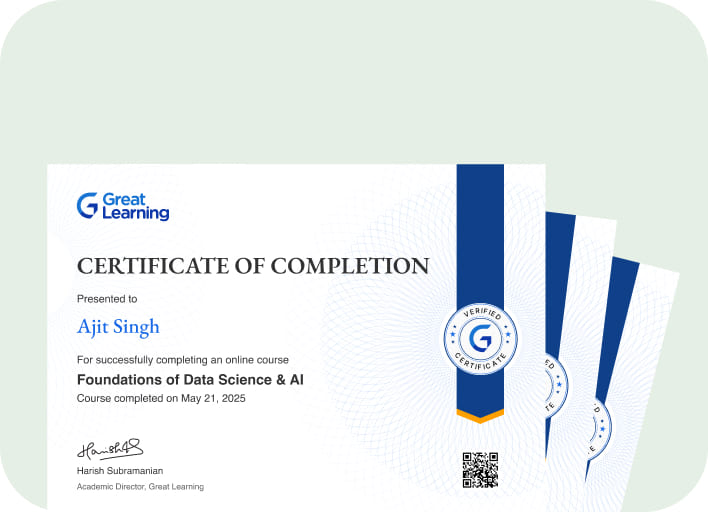
You will receive a certificate after completing all modules. A certificate is available for a nominal fee upon successful completion.
Why is learning Google Gemini useful for accounting?
Gemini helps in:
Automating repetitive tasks
Reducing manual errors
Generating insights faster
It also greatly improves financial analysis, supports decision-making, and speeds up reporting using multimodal AI capabilities.
What modules are included in this course?
The course includes:
Introduction to Gemini and Accounting Fundamentals
Gemini’s Usefulness for Accountants and Managers
Step-by-Step Financial Problem-Solving with Gemini
What skills will I gain after completing this free Gemini course for accounting professionals?
You’ll gain skills in:
Understanding Gemini models
Applying Gemini to core accounting tasks
performing Gemini-assisted financial analysis
using AI to solve accounting problems more efficiently.
Is there any limit on how many times I can take this free course?
No. There is no limit. Once you enrol in the Free Google Bard for Accounting Course, you have lifetime access to it. So, you can log in anytime and learn it for free online.
Who is eligible to take this Free Google Gemini for Accounting Course?
You do not need any prerequisites to learn the course, so enrol today and learn it for free online
How does this course help in real-world scenarios?
By the end of the course, you’ll be able to use Gemini for financial calculations, report generation, reconciliations, and data-driven insights. You’ll also learn how to apply Gemini to everyday accounting workflows, making processes faster and more reliable.
What skills will I gain after completing this free Gemini course for accounting professionals?
You’ll gain skills in:
Understanding Gemini models
Applying Gemini to core accounting tasks
performing Gemini-assisted financial analysis
using AI to solve accounting problems more efficiently.
Become a Skilled Professional with Pro Courses
Gain work-ready skills with guided projects, top faculty and AI tools, all at an affordable price.
 PRO
PRO








 (1).jpg)
.jpg)








.png)


.png)
.png)
.png)
.jpg)
.png)

.png)
.jpeg)
.jpg)
.jpg)

.png)
.png)
.png)

.png)
.png)


.png)
.jpg)
.jpg)
.png)




.png)
.png)
.png)

.png)
.jpg)






 (1).png)

.png)
.png)
.png)
Recommended Free Generative AI courses
 FREE
FREE
 FREE
FREE
.jpg) FREE
FREE
 FREE
FREE

Similar courses you might like
FREE
.jpg) FREE
FREE
 FREE
FREE
 FREE
FREE

Related ChatGPT and Generative AI Courses

-
Scholarships upto ₹25K

McCombs School of Business at The University of Texas at Austin
PG Program in Artificial Intelligence & Machine Learning12 Months · Online
#1 Ranked AI ProgramKnow More
-
Scholarships upto ₹25K
McCombs School of Business at The University of Texas at Austin
Artificial Intelligence PG Program for Leaders5 Months · Online · weekend
No Programming Exp RequiredKnow More
-
6 Months · Online
Know More





Google Bard for Accounting
The integration of artificial intelligence (AI) into accounting practices has revolutionized the way financial data is processed, analyzed, and interpreted. AI technologies have significantly improved efficiency, accuracy, and decision-making capabilities within the accounting profession, enabling accountants to focus on more strategic and value-added tasks. Here's a comprehensive overview of how AI is being used for accounting:
- Automated Data Entry and Bookkeeping: AI-powered software can automate data entry tasks by extracting relevant information from invoices, receipts, and other financial documents. This eliminates the need for manual data entry, reducing errors and freeing up accountants' time for higher-level activities.
- Expense Management and Categorization: AI algorithms can classify and categorize expenses automatically, ensuring accurate allocation of costs and facilitating budgeting and financial planning processes.
- Predictive Analytics: AI-driven predictive analytics can forecast financial trends, cash flow patterns, and potential risks. This empowers businesses to make informed decisions and adapt their strategies accordingly.
- Fraud Detection and Prevention: AI algorithms can analyze large volumes of financial data to identify anomalies and patterns that may indicate fraudulent activities. This proactive approach enhances internal controls and reduces the risk of financial fraud.
- Financial Reporting and Analysis: AI-powered tools can generate real-time financial reports and dashboards, providing actionable insights into a company's financial performance. This enables faster and more informed decision-making.
- Tax Compliance: AI can assist with tax preparation and compliance by analyzing tax codes, regulations, and historical data to ensure accurate and timely filing of tax returns.
- Audit Support: AI can streamline the audit process by analyzing financial records and transactions, identifying discrepancies, and providing auditors with relevant information. This expedites audits and enhances transparency.
- Chatbots and Customer Support: AI-driven chatbots can handle routine customer inquiries related to accounting, such as account balances, payment status, and invoice inquiries. This improves customer service and reduces the workload on accounting teams.
- Cash Flow Management: AI algorithms can predict and manage cash flow by analyzing historical financial data and identifying potential liquidity issues. This helps businesses optimize their cash management strategies.
- Budgeting and Forecasting: AI can enhance budgeting and forecasting processes by analyzing historical financial data, market trends, and external factors to create more accurate and dynamic financial projections.
- Risk Assessment: AI can assess financial risks by analyzing data from various sources, such as market fluctuations, economic indicators, and industry trends. This helps businesses identify and mitigate potential risks.
- Personalized Financial Advice: AI-powered tools can provide personalized financial advice to individuals and businesses based on their financial goals, risk tolerance, and current financial situation.
- Continuous Learning and Improvement: AI systems can learn from historical accounting data, adapt to changing financial regulations, and continuously improve their accuracy and performance over time.
Incorporating AI into accounting practices has the potential to enhance operational efficiency, reduce human error, and provide valuable insights for better decision-making. However, it's important to note that while AI offers numerous benefits, it should be used in conjunction with human expertise to ensure ethical considerations, data security, and the contextual understanding of complex financial scenarios.
As AI technology continues to evolve, the role of accountants is shifting from manual data processing to strategic analysis and interpretation. This transformation enables accounting professionals to provide more value to their organizations by focusing on high-level financial strategy and advisory services.